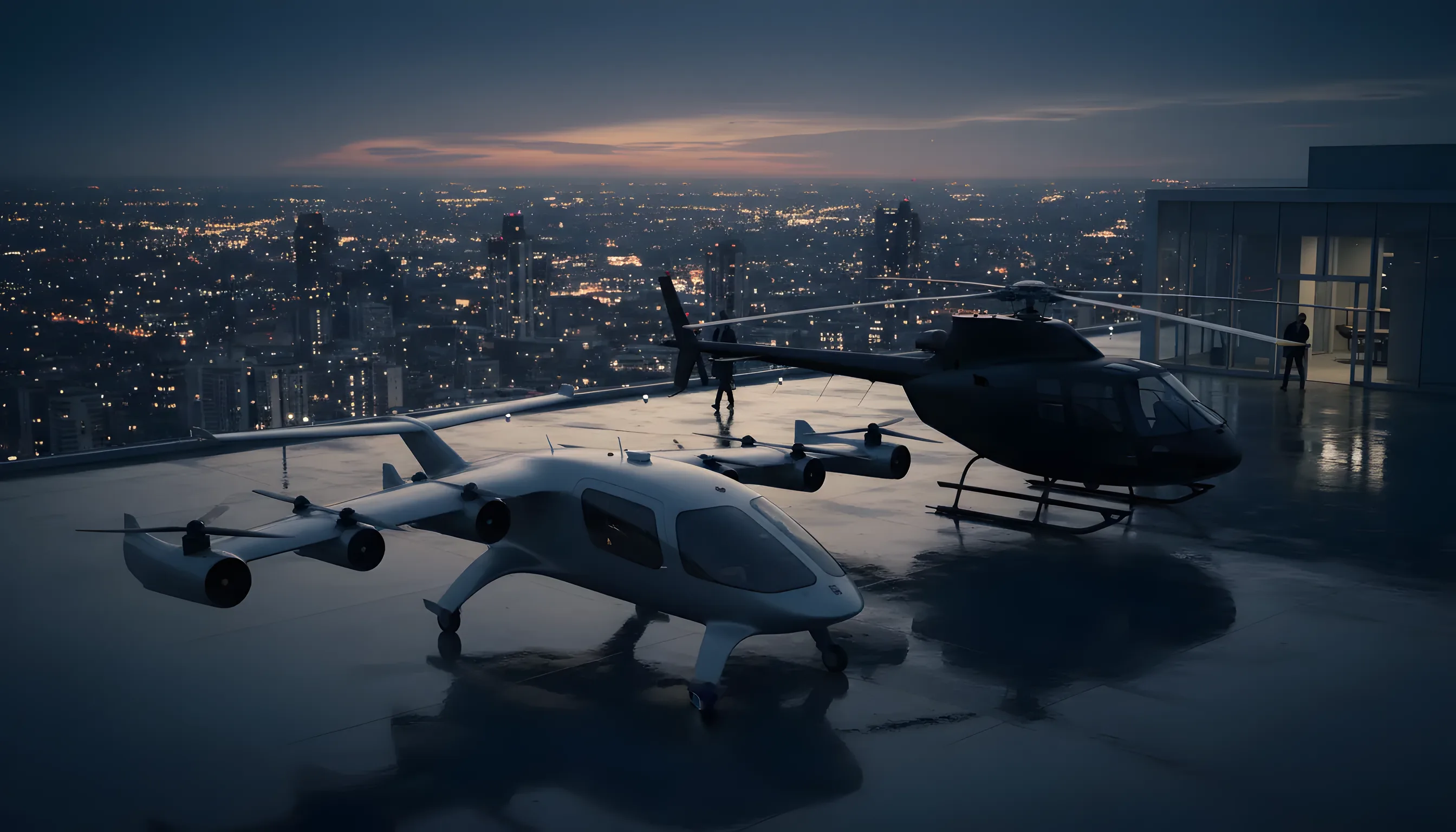
The air taxi vs helicopter debate is reshaping how cities plan the future of transportation. Urban airspace is no longer reserved for emergency services and private charters — a new class of electric vertical take-off and landing aircraft is entering commercial service, and the differences between these two options matter enormously for passengers, operators, and city planners. This article breaks down the key distinctions across technology, cost, noise, regulation, and real-world use cases. The comparison below helps you weigh an eVTOL air taxi for urban commuting against a traditional helicopter for point-to-point travel.
What Is an Air Taxi and How Does It Differ from a Helicopter?
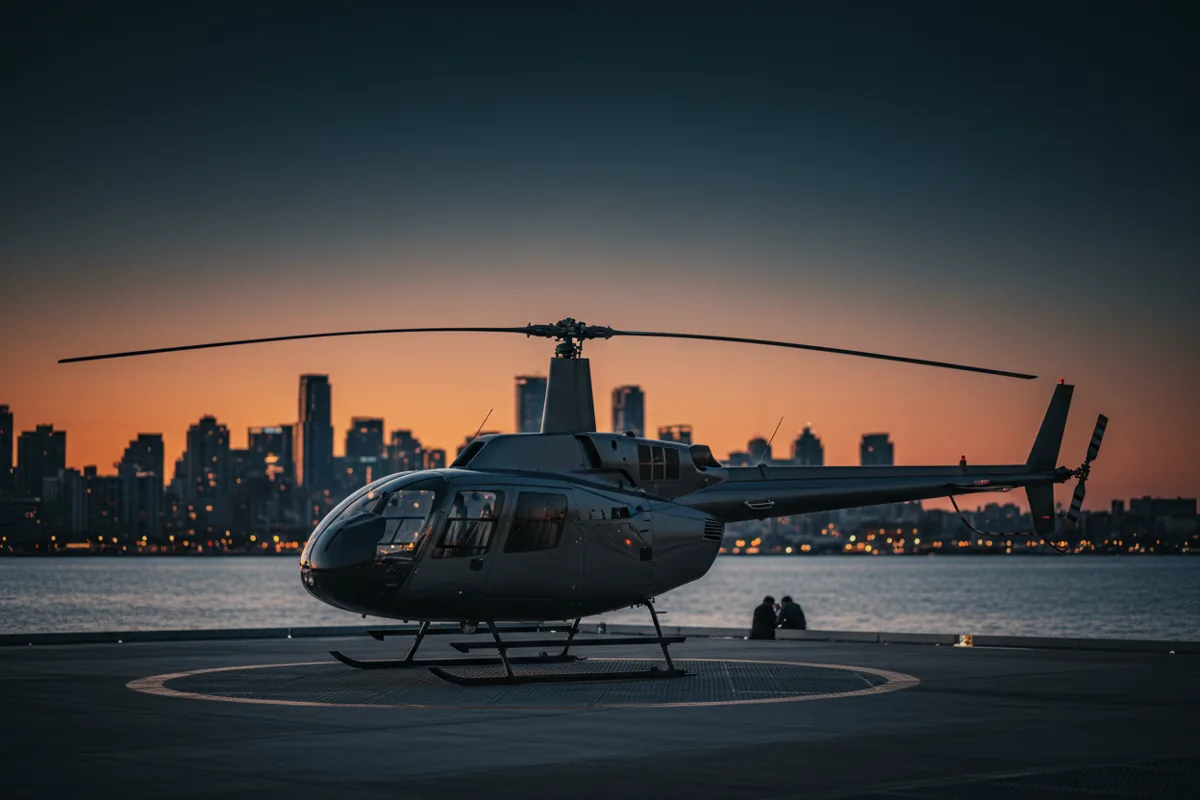
The air taxi vs helicopter debate starts with a basic difference in technology. In Urban Air Mobility (UAM) and Advanced Air Mobility (AAM) plans, an air taxi is an electrically powered or hybrid aircraft designed for on-demand urban and regional transport. In FAA regulations, though, an air taxi is any on-demand flight for hire, including by helicopter. Unlike helicopters, air taxis use eVTOL (electric vertical take-off and landing) technology or vectored thrust VTOL systems — not conventional rotor assemblies powered by turbine engines.
How UAM and AAM Define the Air Taxi Category
The FAA's Advanced Air Mobility roadmap classifies air taxis as a new category of aircraft that transports passengers and freight from one location to another using electric or hybrid-electric propulsion. UAM focuses on urban routes under 50 miles. AAM extends that scope to regional corridors and cargo operations.
What Makes eVTOL Aircraft Different from Conventional Rotorcraft
Three core differences separate eVTOL aircraft from helicopters:
- eVTOL aircraft use distributed electric propulsion — multiple smaller rotors or fans instead of one large main rotor
- Vectored thrust VTOL designs, like those developed by Penta Aero, redirect thrust direction rather than relying on rotor pitch changes
- Helicopters depend on mechanical tail rotors for yaw control; eVTOL aircraft use differential motor speed or thrust vectoring instead
How Do Air Taxis and Helicopters Compare Across Key Factors?
The table below captures the six factors that matter most when comparing air taxis and helicopters side by side.
| Factor | Air Taxi (eVTOL) | Traditional Helicopter |
|---|---|---|
| Propulsion | Electric motors | Fossil-fuel turbine/piston |
| Noise level | Significantly quieter | Loud rotor noise |
| Operating cost | Lower (fewer moving parts) | Higher maintenance |
| Passenger capacity | 4–6 typically | 4–12 depending on model |
| Infrastructure needed | Vertiport | Helipad |
| Carbon footprint | Near-zero emissions | High emissions |
Electric motors eliminate the mechanical complexity that drives helicopter maintenance costs higher. Fewer moving parts translate directly into lower per-flight operating expenses for eVTOL operators. On noise, the difference is measurable — distributed electric propulsion produces a fraction of the acoustic signature of a turbine engine. Noise reduction claims from manufacturers are beginning to carry specific numbers: Volocopter reports 65 dBA at 75 meters during hover — a level it describes as three times quieter than a helicopter in the same flight attitude — and 65 dBA at 120 meters during overflight, described as 4–5 times lower than a comparable helicopter. What people think of air taxis: pros and cons as reported in a German survey Travelers comparing options in U.S. cities can look at BLADE, which offers helicopter charters today and is preparing for eVTOL integration.
Are Air Taxis Safer Than Helicopters?
Safety comparisons between air taxis and helicopters require a systems-level view rather than a headline answer.
eVTOL aircraft use redundant motor arrays, meaning the failure of one motor does not disable the aircraft. Traditional single-engine helicopters have no equivalent redundancy — engine failure demands an immediate autorotation maneuver that depends heavily on pilot skill and altitude.
That said, eVTOL certification pathways through the FAA and EASA are still maturing. The FAA's Advanced Air Mobility roadmap acknowledges that airworthiness standards for novel propulsion configurations remain under active development. Manufacturer certification filings reflect ongoing dialogue with regulators rather than finalized approvals.
Helicopters carry decades of operational safety data. eVTOL aircraft do not yet match that record simply because the flight hours do not exist. Both factors — redundant architecture and regulatory immaturity — belong in any honest safety assessment.
Which Is Better for Urban Transportation: Air Taxi or Helicopter?
For urban transportation, air taxis present a more sustainable long-term solution than helicopters. Electric vertical take-off and landing aircraft produce significantly less noise, making them compatible with city-center vertiports where helicopter operations face strict ordinances. Policy is beginning to formalize this shift: the City of New York has announced plans to electrify the Downtown Manhattan Heliport and convert it into a sustainable transport hub for eVTOLs, while New York City Council initiatives are seeking to restrict non-essential helicopter operations on city heliports to all-electric aircraft as a noise reduction measure. Helicopters hold one clear advantage today: established infrastructure, including helipads, maintenance networks, and trained crews.

Vectored thrust VTOL designs, such as those developed by Penta Aero, are a middle-ground approach. These aircraft combine helicopter-like flexibility with the efficiency gains of eVTOL propulsion systems, addressing urban range and noise constraints simultaneously.
The congestion problem air taxis aim to solve is significant: according to Inrix (2019), the average commuter loses about 99 hours a year to traffic congestion — a productivity and quality-of-life drain that ground-based alternatives have failed to resolve. Recommendations for emerging air taxi network operations based on online review analysis of helicopter services Real-world route projections illustrate the urban mobility case: Archer Aviation and United Airlines have publicly stated that their planned Newark-to-Manhattan air taxi service would take approximately 10 minutes — versus over an hour by car or public transit — at a target price of around $100 per passenger. Which flying taxi will take off first?
The FAA's Advanced Air Mobility roadmap projects meaningful UAM ecosystem buildout through 2028, with commercial air taxi corridors becoming operational in select cities before 2030. Urban commuters choosing between these two transportation modes today should recognize that the AAM transition is measured in years, not decades.
What Are the Main Limitations of Each Option Today?
Both technologies carry real constraints that buyers and city planners must weigh today.
Current air taxi limitations include:
- Battery energy density restricts most eVTOL aircraft to ranges under 60 miles per charge
- Vertiport infrastructure remains underdeveloped in virtually every major metro area
- FAA certification timelines for AAM platforms continue to extend beyond original manufacturer projections
- Passenger capacity stays low, limiting revenue per flight for operators
Cost adds to the regulatory delays. Industry estimates place the cost of developing a single eVTOL aircraft through full certification at approximately $1 billion, which puts heavy pressure on startup capital and investor confidence.
Helicopter limitations are equally significant:
- Noise pollution creates community resistance that blocks expansion into dense urban corridors
- Jet fuel combustion produces emissions incompatible with urban air quality standards
- Per-seat operating costs run three to five times higher than ground-based premium transportation
- A documented pilot shortage across the U.S. constrains fleet scalability
Neither system is ready to serve high-frequency UAM demand at scale without addressing these barriers first.
What Does the Future of Air Taxi vs Helicopter Look Like?
The FAA's Advanced Air Mobility roadmap outlines a phased integration of eVTOL aircraft into national airspace, with commercial urban air taxi operations targeted for the late 2020s. As UAM networks scale, eVTOL air taxis will handle short urban hops with lower cost and higher frequency than traditional rotorcraft. Helicopters will not disappear. Conventional rotorcraft retain clear advantages in cargo transport, emergency medical services, and long-range missions beyond electric battery limits. The AAM trajectory points toward a two-tier system: eVTOL platforms on city-center routes, and helicopters on missions that need more range, payload, or all-weather capability.

Final Verdict: Air Taxi vs Helicopter — Which Wins?
The air taxi vs helicopter debate ultimately comes down to purpose, technology, and economics. Traditional helicopters remain proven workhorses for emergency services, remote freight delivery, and specialized operations. However, eVTOL aircraft are redefining what urban air transportation looks like — quieter, cleaner, and purpose-built for high-frequency passenger movement across cities.
Advanced Air Mobility is a major shift in how transportation will work. Designs like Penta Aero's vectored thrust VTOL show that AAM and UAM solutions are no longer theoretical. Certification filings and FAA Advanced Air Mobility roadmap milestones point to commercial operations within the next few years.
For urban commuters, planners and investors, eVTOL air taxis offer advantages that helicopters cannot match at scale. Until they launch, helicopters remain the fast option, and certification progress is the milestone to watch.