
Key takeaway:
- "Private airline" is an everyday name for companies that fly private jets, helicopters and turboprops for paying passengers, mostly by charter.
- In the United States, the rules depend on how the flight is sold: private flights, on-demand charters, public charters and scheduled airlines each fall under different regulations.
- You can fly privately by chartering a whole aircraft or by buying a single seat on a shared flight.
People search for "private airlines" when they want to fly without the airline experience: no crowded terminal, no fixed schedule, and a smaller cabin. This guide explains what the term really covers, how these flights are regulated, how they compare with commercial airlines, and how to book one.
Definition of Private Airlines
There is no formal category called a "private airline." The term usually refers to companies that carry passengers on smaller aircraft, such as business jets, helicopters and turboprops, outside the airline system.
In the United States, the regulations draw the lines:
- Private flights (Part 91). Non-commercial flights, such as an owner flying their own jet, operate under the general operating rules of 14 CFR Part 91.
- On-demand charter (Part 135). When an operator flies passengers for compensation, on a schedule the customer chooses, it must hold an operating certificate and follow 14 CFR Part 135. Most private jet charter falls here.
- Scheduled airlines (Part 121). Airlines and large-aircraft supplemental carriers operate under 14 CFR Part 121.
- Public charters (Part 380). A charter operator can arrange one-way or round-trip charter flights that are performed by a direct air carrier and sold to the public under DOT rules in 14 CFR Part 380.
Many companies that sell private flights do not fly the aircraft themselves. An air charter broker arranges the flight with a licensed operator. Under DOT rules in 14 CFR Part 295, the broker must tell you before you sign which operator has operational control of the aircraft, the capacity in which the broker is acting, and whether it carries broker liability insurance.
BLADE works this way. For flights in the United States, BLADE acts as an air charter broker and indirect air carrier, and all flights are operated by DOT/FAA licensed direct air carriers.
Importance and Role of Private Airlines
Private operators fill the gaps that airlines leave: short hops airlines do not fly, smaller airports they do not serve, and trips where the timing matters more than the fare. They also carry passengers on routes where road traffic makes the trip slow, such as between Manhattan and the New York airports.
Evolution and Growth of Private Airlines

Early Development of Private Airlines
Private aviation grew from companies and wealthy owners flying their own aircraft. Over time, charter operators made the same aircraft available by the trip, so a traveler could fly privately without owning a jet.
Expansion and Diversification of Services
Today, private flying comes in several forms:
- Full charter. You book the whole aircraft and choose the time and the airports.
- Shared charter and crowdsourcing. You book an aircraft and sell the seats you do not need. With BLADE, unused seats you crowdsource are sold in the BLADE app and credited back to you as BLADE credits.
- By-the-seat flights. You buy a single seat on a scheduled private flight. BLADE sells seats between Manhattan and JFK or Newark, about 5 minutes from $195 per seat, and between Manhattan and the Hamptons in summer, from $795 per seat.
- Semi-private jets. BLADEone offers flights between Westchester and Miami or Palm Beach on a commercial-sized jet with 16 seats. Manhattan passengers can connect by helicopter to the jet in about 12 minutes.
- Ownership programs. Buyers can own a full aircraft or a share in one.
Benefits of Flying with Private Airlines
Convenience and Flexibility
- You choose the departure time on a charter.
- You can use smaller airports closer to your destination.
- You fly direct, without connecting through a hub.
- Some services include private lounges at both ends.
Enhanced Comfort and Privacy
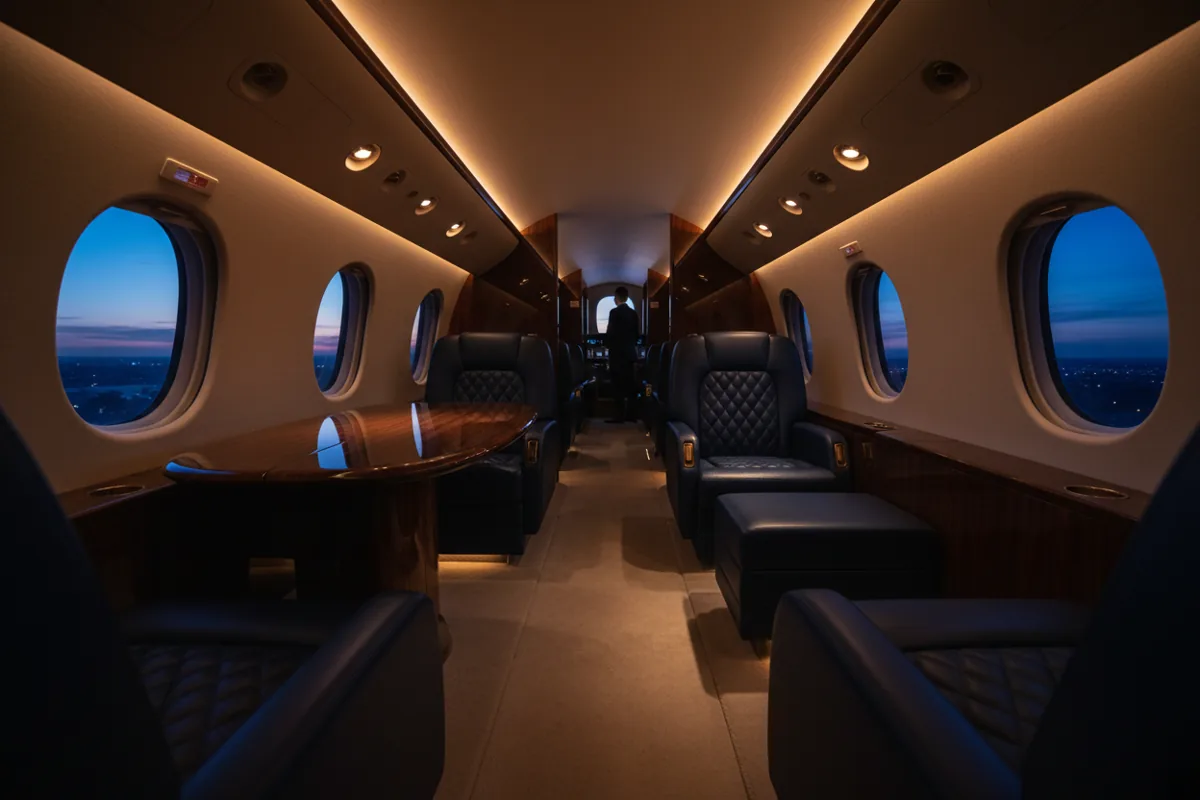
The cabin holds only your group or a small number of passengers. That means more space, quieter boarding and the option to work or rest without strangers around you. On larger jets, cabins can include separate areas for dining, working and sleeping.
Comparison of Private Airlines with Commercial Airlines
Differences in Services and Amenities
| Private flights | Commercial airlines | |
|---|---|---|
| Schedule | You choose (charter) or a small schedule (by the seat) | Fixed timetable |
| Airports and terminals | Private terminals and smaller airports | Main airline terminals |
| Passengers | Your group, or a small shared cabin | Up to hundreds per flight |
| Regulation (US) | Usually Part 135 charter, or Part 91 for private owners | Part 121 |
| Booking | Through an operator or a broker | Through the airline or an agent |
Security screening also differs. TSA requires full passenger screening for private charters only in certain cases, such as when passengers board from a sterile area or the aircraft is very large.
Cost Comparisons and Value for Money
A private charter costs more than an airline ticket for one person. The gap narrows for a group splitting one aircraft, and it narrows again on by-the-seat flights, where you pay only for your seat. Value comes from the time saved, not the fare. Compare the total door-to-door time, including the drive to the airport and the wait at security.
Future Trends and Innovations in Private Airlines

Technological Advancements in Aircraft
Electric vertical takeoff and landing aircraft (eVTOLs) are the next step for short city flights. The FAA's rules for training and operating powered-lift aircraft took effect on January 21, 2025. Joby Aviation, which acquired BLADE's passenger business in August 2025, is in the final stage of FAA type certification and has not yet received a type certificate. After certification, Joby intends to bring its eVTOL aircraft into BLADE's operations over time. Until then, BLADE flights continue on conventional helicopters, seaplanes and jets.
Sustainability and Environment-Friendly Initiatives
Operators and manufacturers are working on more fuel-efficient aircraft, alternative fuels and electric aircraft. Ask your operator what options are available for your flight.
Conclusion
"Private airline" is a loose name for a range of services: private flights, on-demand charters, public charters and by-the-seat private flights. The aircraft are smaller, the schedule is yours or close to it, and you avoid the main terminal. Before you book, check who operates the aircraft and under which rules it flies.
Some Facts About Private Airlines:
- Private flights for paying passengers in the United States usually operate under 14 CFR Part 135.
- Air charter brokers must disclose the operator in operational control before you contract.
- Business jets range from very light jets and light jets to mid-size, super mid-size, large and ultra-long-range jets.
- Well-known business jet manufacturers include Bombardier, Cessna, Dassault Aviation, Embraer, Gulfstream Aerospace and Beechcraft.
FAQs about Private Airlines
What is a private jet?
A private jet, also called a business jet, is a jet aircraft built to carry a small group of passengers. Owners, companies and charter operators fly them for business and leisure.
What is a mid-size jet?
A mid-size jet is a class of business jet that sits between light jets and larger jets in cabin size.
What is a corporate jet?
"Corporate jet" and "executive jet" are other names for a business jet, especially one a company owns or charters for its staff.
Which entities use business jets?
Companies, private owners, charter operators, governments and armed forces all fly business jets.
What are turbofan engine aircraft?
A turbofan is the type of jet engine used on modern business jets. It uses a fan to produce thrust from a combination of fan air and jet exhaust, and it is known for its efficiency.
How can I request information about private airlines?
To book a private flight with BLADE, use the BLADE app or blade.com, or call Flier Relations at +1 844-359-2523, available 7 days a week.