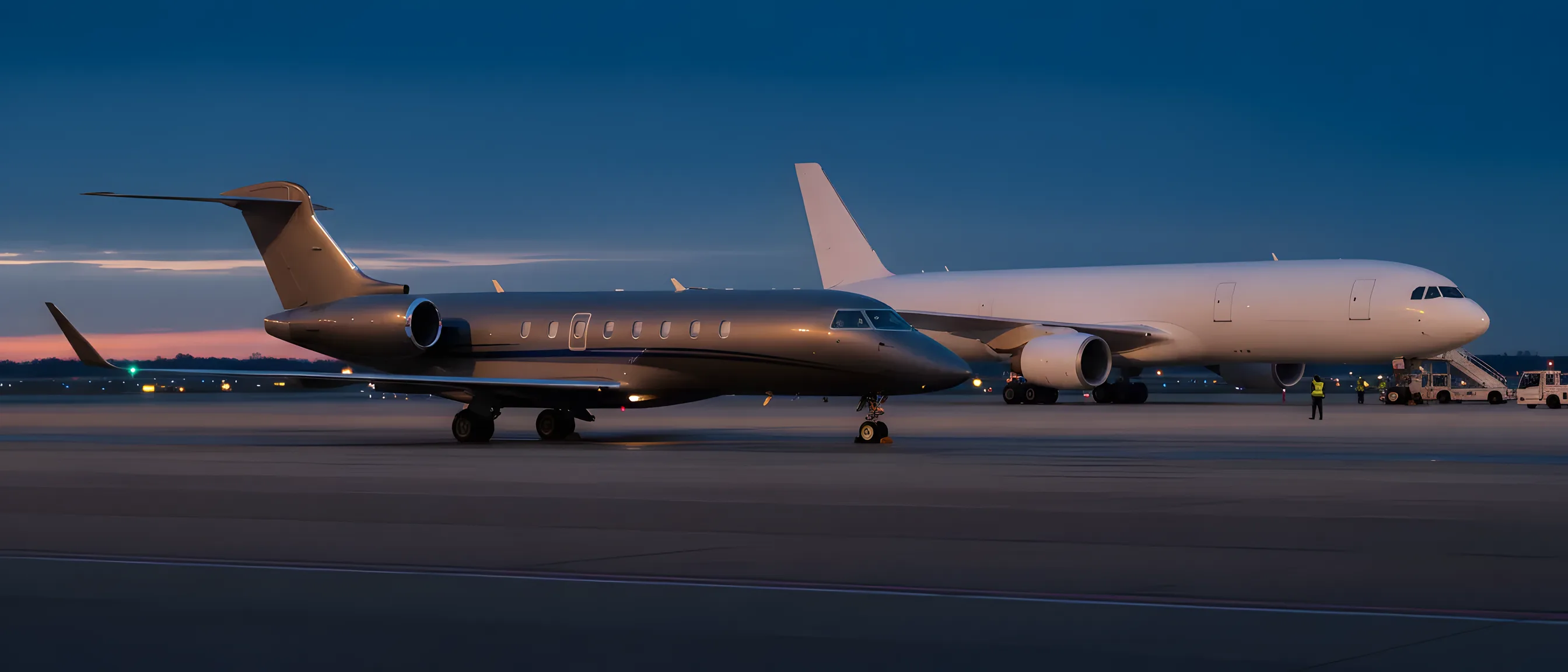
For private jet passengers, crossing the country in under four hours is routine. How fast are private jets compared to commercial airlines? Private jets cruise at true airspeeds of roughly 480 to 610 mph, while most commercial airliners cruise around 520 to 570 mph. With a strong jet stream tailwind, a private jet's ground speed can briefly exceed 700 mph, though that is wind assistance, not airspeed. The gap is real, but raw airspeed only tells part of the story. Door-to-door travel time is where private aviation saves the most. This article covers the speed differences between private and commercial flight, the aircraft and engines behind them, and why flying private is usually faster door-to-door even when the jets aren't quicker in the air.
Private Jets vs. Commercial Planes: Speed by the Numbers
The speed gap between private jets and commercial airliners is more nuanced than a single number. The table below compares cruising speeds across aircraft categories to show exactly where each type sits.
| Aircraft Category | Example Aircraft | Cruising Speed (Knots) | Cruising Speed (MPH) |
|---|---|---|---|
| Light jet | Cessna Citation CJ3+ | 416 kts | 479 mph |
| Midsize jet | Cessna Citation X | 528 kts | 607 mph |
| Heavy jet | Gulfstream G550 | 488 kts | 562 mph |
| Ultra-long-range jet (fast) | Gulfstream G650/G700 | 516 to 528 kts | 594 to 607 mph |
| Ultra-long-range jet | Bombardier Global 7500 | 516 kts | 594 mph |
| Narrow-body commercial | Boeing 737 MAX | 453 kts | 521 mph |
| Wide-body commercial | Boeing 747-8 | 493 kts | 567 mph |
Typical Cruising Speeds for Private Jets
Private jet cruising speeds range from roughly 400 knots for light jets up to 528 knots for the Cessna Citation X, one of the fastest civilian aircraft ever built and quicker than any airliner in commercial service. The fastest Gulfstreams, the G650, G650ER, and G700, cruise at up to Mach 0.90 and can be pushed to Mach 0.925, matching or beating every commercial widebody. Aircraft design and engine power drive these differences: aerodynamics, airframe weight, and turbofan efficiency all determine the ceiling a jet can reach. Midsize and heavy jets are the sweet spot for transcontinental travel, where higher cruising altitudes and sustained speeds compress total flight time meaningfully. If you start with NYC helicopter airport transfers to skip ground traffic and then board a private jet, the time savings add up across the trip.
Typical Cruising Speeds for Commercial Airliners
Commercial airliners cruise between 450 and 500 knots as a standard operational range. The Boeing 747-8 reaches approximately 493 knots (about 567 mph), while the Boeing 737 MAX sits closer to 453 knots (about 521 mph). These speeds are optimized for fuel efficiency at scale, not maximum velocity. Airlines also factor airspace congestion, scheduled departure windows, and air traffic control routing into flight planning, all of which reduce effective travel speed. Travelers comparing private air taxi vs. commercial options frequently find the private speed advantage is most visible on routes where commercial scheduling adds hours of indirect routing or layover time.
How Much Faster Is a Private Jet Than Commercial?
In pure cruising airspeed, the difference is modest: the fastest private jets (the Citation X and top Gulfstreams) cruise roughly 30 to 50 mph faster than a typical narrow-body airliner, and about even with the fastest widebodies. On paper, that alone would save only minutes on a two-hour flight.

The real gap opens up in total journey time. Once you add the commercial overhead, arriving 2 to 3 hours early, security lines, boarding queues, taxi delays, layovers, and the transfer from a distant major airport, private aviation often saves 2 to 4 hours door-to-door on a domestic trip, even when the airspeed difference is small. On a route like New York to Miami, a private flight can cut total elapsed travel time roughly in half versus a connecting commercial itinerary, not because the jet flies dramatically faster, but because almost none of the trip is spent waiting.
What Is the Maximum Speed of a Private Jet?
Cruising speed and maximum speed are different numbers. The figures above are typical cruise speeds; most jets have a higher maximum operating speed (Mmo), expressed as a Mach number, that they can reach briefly but rarely sustain for fuel-efficiency reasons.
- Cessna Citation X / X+: cruises around 528 knots, with a maximum operating speed near Mach 0.935, making it one of the fastest civilian aircraft ever built
- Gulfstream G650 / G700: cruise up to Mach 0.90 and reach Mach 0.925 maximum
- Bombardier Global 7500 / 8000: cruise near Mach 0.85 with high-speed capability up to Mach 0.925, and the Global 8000 is designed to reach Mach 0.94
- Light jets: typically max out around Mach 0.70 to 0.80
For reference on the exact figures searchers look for: 453 knots is roughly the 737 MAX cruise, 493 knots the 747-8, and 528 knots the Citation X, so a private jet at its fastest cruise is running about 75 knots quicker than a common narrow-body airliner.
Why Are Private Jets Sometimes Faster Than Commercial Flights?
Private jets reach higher true airspeeds than commercial aircraft for three interconnected reasons: altitude, airframe design, and engine power relative to aircraft weight. Understanding each clarifies why door-to-door travel time on a private flight frequently beats the commercial experience even when listed cruising speeds look similar on paper.
Cruising Altitude and Thinner Air
Private jets routinely cruise between 41,000 and 51,000 feet. Commercial airliners typically operate between 30,000 and 38,000 feet. The difference matters because air density drops significantly above 40,000 feet, reducing aerodynamic drag on the airframe. Less drag means the aircraft sustains a higher true airspeed at the same engine thrust. True airspeed measures actual speed through the air mass, while indicated airspeed reflects air pressure on sensors, and the two diverge sharply at altitude. A private jet at 51,000 feet achieves a greater true airspeed than a commercial jet at the same indicated airspeed at 35,000 feet. Higher cruising altitude also places private jets above most commercial traffic and weather, making routing more direct.
Aircraft Design and Aerodynamics
Private jets carry far less structural mass than widebody commercial aircraft. The Cessna Citation X, for example, has a maximum takeoff weight of roughly 36,000 pounds. A Boeing 747 exceeds 900,000 pounds. Lighter airframes require less thrust to accelerate and sustain speed, which translates directly into quicker climb rates and higher cruising velocities. Swept wings and streamlined fuselages on modern private jets also reduce parasitic drag at high altitude.
Engine Power and Efficiency
Private jets generate high thrust relative to their total weight. This power-to-weight ratio allows faster acceleration, higher cruise speeds, and better fuel efficiency per nautical mile at altitude. Private jet charter management programs choose aircraft on these performance metrics, matching engine output to mission distance and speed.
How Do Jet Streams, Tailwinds, and Headwinds Affect Private Jet Speed?
Airspeed and ground speed are two different measurements, and confusing them distorts speed comparisons. Airspeed measures how fast an aircraft moves through the surrounding air mass. Ground speed measures how fast it moves relative to the earth's surface, and that number changes dramatically with atmospheric conditions.
Jet streams are high-altitude air currents that flow between 80 and 140 knots, sometimes far faster. Private jets flying above 40,000 feet gain direct access to these corridors. A well-positioned tailwind can push ground speed beyond 700 mph on transatlantic routes, while a headwind of equal strength cuts that figure significantly. This is the source of the "711 mph" figure sometimes cited for private jets, it is a wind-assisted ground speed, not the aircraft's true airspeed. Flexible routing lets private operators seek favorable jet streams or sidestep headwinds, a routing adjustment commercial airlines rarely make due to fixed schedules and airspace constraints.
Colder temperatures at cruising altitude also increase air density, improving engine efficiency and raising the thrust-to-drag ratio.
Is Door-to-Door Travel Time Really Faster on a Private Jet?
Door-to-door travel time shows whether private aviation is faster than commercial. Raw airspeed comparisons favor commercial widebodies on long routes, but total journey time, from home to destination, consistently favors private jet travel across short and medium-distance city pairs. As covered in executive travel time savings, cutting pre-flight waiting matters as much as airspeed.
Private Terminal Access and Ground Operations
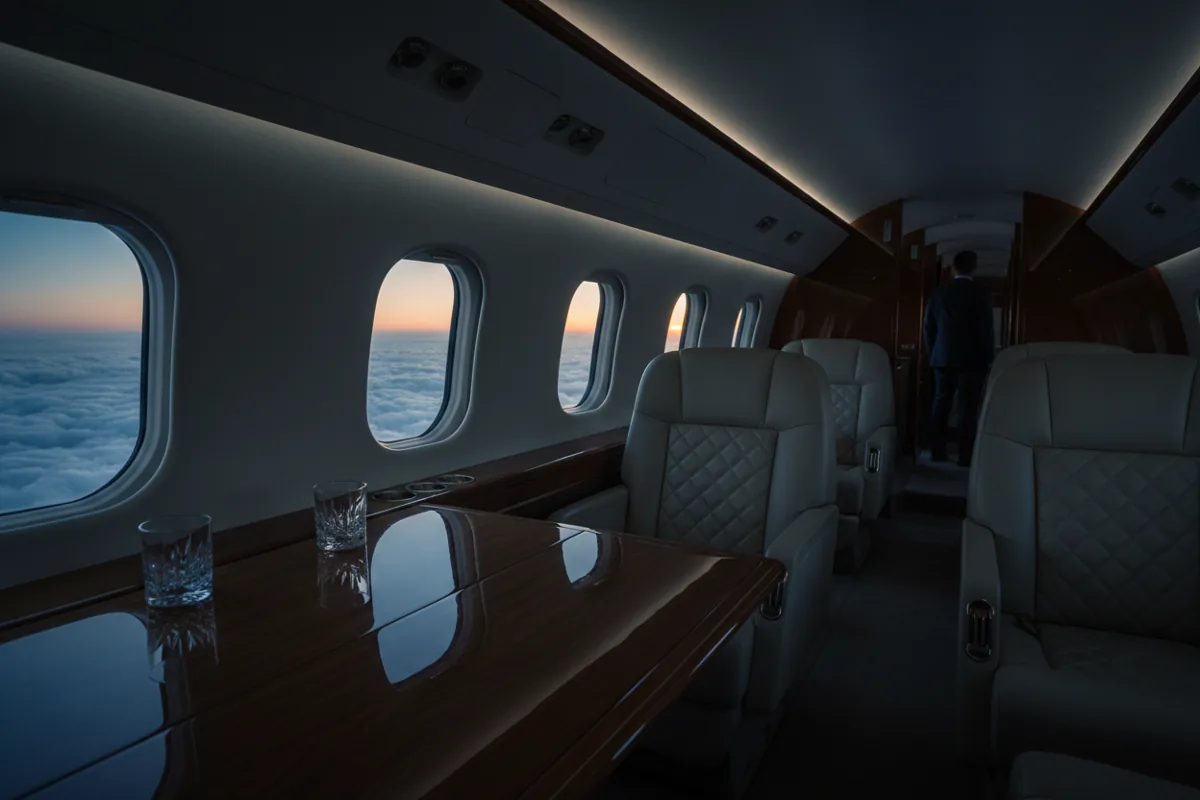
Private jets depart from Fixed Base Operators (FBOs), not commercial terminals. Passengers on most private flights arrive about 15 minutes before departure, skip the TSA checkpoint, and board within minutes. There are no gate holds, no jet bridges, and no 200-person boarding queues. On a route like NYC to Miami, that eliminates 90 to 120 minutes of pre-flight friction alone.
Flexible Routing and Smaller Airport Access
Private aircraft access over 5,000 U.S. airports, compared with roughly 500 served by commercial carriers. Flying into Teterboro (TEB) instead of JFK, or Opa-locka Executive instead of Miami International, cuts ground transfer time on both ends. For the ground segments, see luxury airport transfer to NYC airports. BLADE also offers helicopter transfers that replace the final ground leg, which shortens total travel time.
What About Wi-Fi and Onboard Speed?
Speed isn't only about airspeed. Connectivity increasingly defines the private travel advantage: many private jets now offer high-speed satellite Wi-Fi, including Starlink installations, that can outperform the often slow, capped Wi-Fi on commercial flights. For business travelers, reliable in-flight internet turns cruising time into productive time, extending the private jet's real-world time advantage beyond the airspeed comparison.
What Speed Regulations Apply to Private Jets?
The FAA enforces a 250-knot indicated airspeed limit below 10,000 feet for all aircraft in U.S. airspace, private jets included. Above that altitude, no federal speed ceiling applies, which is why cruising altitudes are where both private and commercial aircraft reach their performance limits. International flights follow ICAO standards, which impose similar low-altitude restrictions across most member states, affecting transatlantic and cross-border private routes equally. Supersonic flight over populated U.S. land remains prohibited under FAA rules, a limitation that emerging supersonic designs, such as Boom Supersonic's Overture airliner, are actively engineering around.
When Does a Commercial Flight Actually Beat a Private Jet?
Commercial flights win on specific routes and conditions. A Boeing 747 cruises around 567 mph and covers transatlantic distances without fuel stops, a range that forces smaller private jets to land mid-journey, adding hours to total travel time. On ultra-long-haul routes exceeding 4,000 miles, a lighter private jet that needs a fuel stop can lose the door-to-door race. Airline route optimization and bulk fuel efficiency also favor commercial carriers on those corridors. That said, ultra-long-range jets like the Gulfstream G650ER and Global 7500 now fly many of those routes nonstop, narrowing the commercial advantage considerably. For a longer-trip example, see Private Jet Charter: Four Seasons Luxury Travel Experience.
Future Aircraft Designs That Will Make Private Jets Even Faster
Emerging designs are set to push private aviation well beyond today's cruising speeds. Supersonic travel represents the most significant leap, with projects like Boom's Overture airliner and the now-discontinued Aerion AS2 business jet concept showing serious industry investment in faster-than-sound travel. These target cruising speeds above Mach 1.4, roughly 925 mph, which would cut transatlantic times dramatically. Advanced composite materials reduce airframe weight while improving structural integrity at altitude, and next-generation engines convert fuel into thrust more efficiently than current turbofans. Meanwhile, subsonic flagships like the Gulfstream G800 and Bombardier Global 8000 are already pushing sustained cruise toward Mach 0.94. Together, these point to higher sustained airspeeds.

Bottom Line: Private Jets Are Faster, But the Full Picture Is More Nuanced
Private jets outpace commercial airliners on raw speed, but the true advantage lies in total door-to-door travel time. A Cessna Citation X cruises at about 607 mph (528 knots), while a Boeing 747 tops out around 567 mph (493 knots), a meaningful gap that widens further when you factor in cruising altitude, aircraft design, and access to smaller airports. Private flights eliminate the hours lost to check-in lines, security queues, and gate delays that erode commercial journeys. Tailwinds and favorable jet streams can push private ground speed even higher, while headwinds affect both aircraft types but are managed more precisely on private routes. If your time is the scarcest resource, the speed advantage of private aviation is clear. Exploring empty leg flights is one way to access that speed at a significantly reduced cost.
Frequently Asked Questions
Are private jets faster than commercial airlines?
In cruising airspeed, the fastest private jets (the Citation X and top Gulfstreams, at about 528 knots or 607 mph) are quicker than most narrow-body airliners and roughly match the fastest widebodies. The bigger advantage is door-to-door: private flights skip the 2 to 3 hours of commercial overhead, so total travel time is usually far shorter.
How fast do private jets fly?
Most private jets cruise between about 400 knots (479 mph) for light jets and 528 knots (607 mph) for the fastest midsize and ultra-long-range jets. Maximum operating speeds run higher, up to around Mach 0.925 to 0.94 on the quickest models.
How much faster is a private jet than a commercial plane?
In airspeed, roughly 30 to 75 mph faster than a typical narrow-body airliner. In total journey time, private flights commonly save 2 to 4 hours on a domestic trip by eliminating security lines, boarding queues, layovers, and long transfers from major airports.
What is the fastest private jet?
The Bombardier Global 8000 is now the fastest, with a top speed of Mach 0.95, while the Cessna Citation X and X+ are among the fastest civilian aircraft ever built, cruising near 528 knots (607 mph) with a maximum operating speed around Mach 0.935. The Gulfstream G650, G700, and Bombardier Global series are close behind at up to Mach 0.925.
What is the difference between airspeed and ground speed?
Airspeed is how fast the aircraft moves through the air; ground speed is how fast it moves over the earth. A jet stream tailwind can push ground speed hundreds of mph above airspeed, which is why private jets sometimes record ground speeds over 700 mph without flying faster through the air.
Do private jets have better Wi-Fi than commercial flights?
Often, yes. Many private jets now offer high-speed satellite Wi-Fi, including Starlink, that outperforms the slower, capped connections common on commercial flights, extending the private time advantage into productive work time.