
Introduction
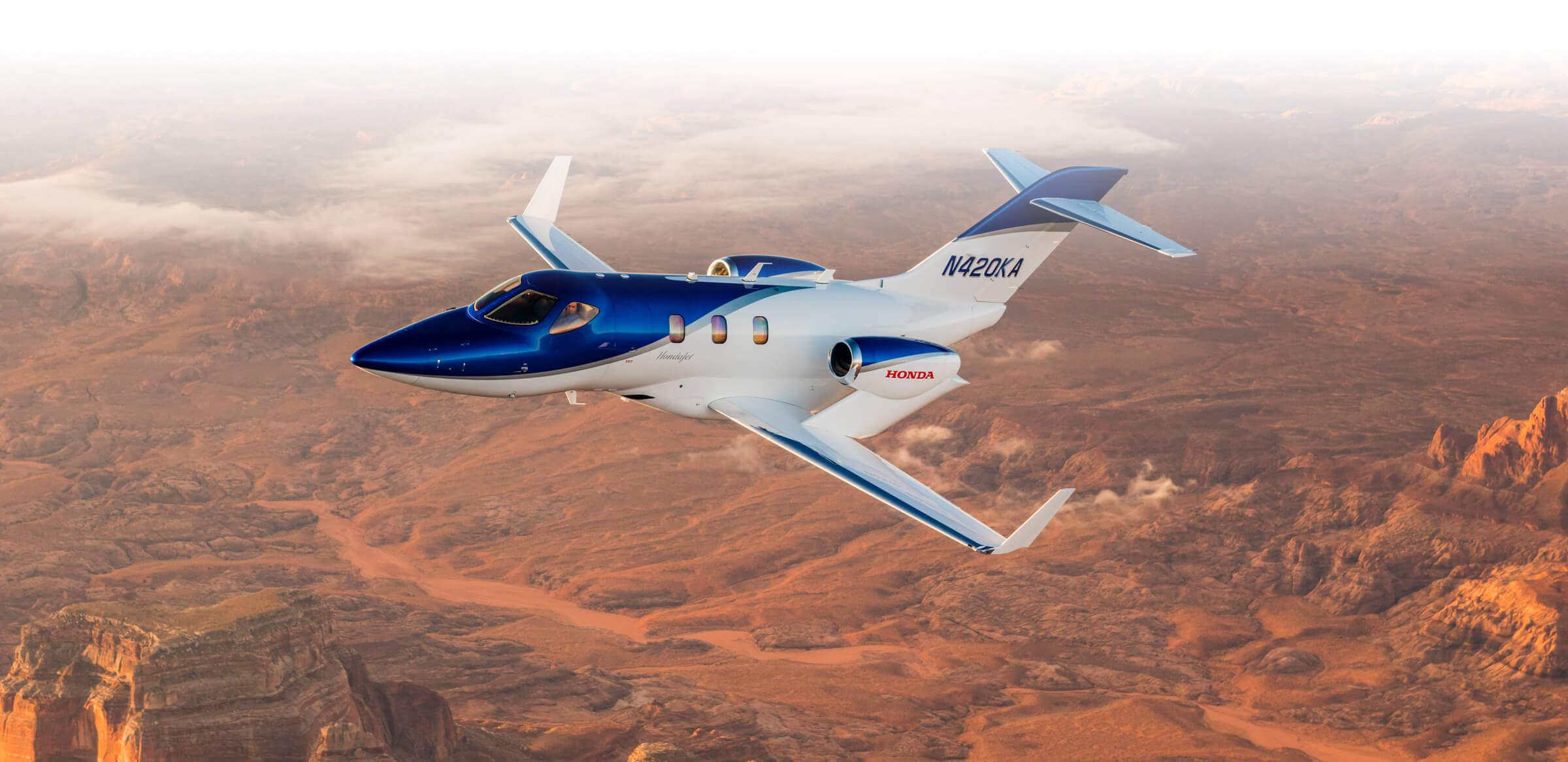
The HondaJet is easy to recognize, thanks to the two engines mounted above the wings. It is built for short and medium trips with a small group: a business day trip, a weekend away or a regional hop that would take most of a day by car.
Honda Aircraft Company builds the HondaJet at Piedmont Triad International Airport in Greensboro, North Carolina. The current production model is the HondaJet Elite II.
Overview of HondaJet
History and evolution of HondaJet
- 1997 to 1999: Honda develops the original concepts for the aircraft.
- December 3, 2003: A proof-of-concept HondaJet makes its first flight in Greensboro.
- 2006: Honda announces it will bring the jet to market.
- December 2015: The HA-420 HondaJet receives its FAA type certificate, and the first customer aircraft is delivered on December 23, 2015.
- 2018: The HondaJet Elite arrives with more range, an improved interior and an updated flight deck.
- November 2, 2022: The HondaJet Elite II receives FAA certification, with more fuel, a higher gross weight and a Garmin G3000 flight deck.
Range has grown with each version: 1,223 nm for the original HondaJet, 1,437 nm for the Elite and 1,547 nm for the Elite II.
Models and specifications
The specifications below are Honda Aircraft's figures for the HondaJet Elite II.
| Specification | HondaJet Elite II |
|---|---|
| Maximum cruise speed | 422 KTAS (FL300, ISA) |
| NBAA IFR range | 1,547 nm (4 occupants) |
| Maximum cruise altitude | 43,000 ft (FL430) |
| Takeoff distance | 3,699 ft (SL, ISA, MTOW) |
| Landing distance | 2,717 ft (4 occupants, unfactored) |
| Length / wingspan / height | 42.62 ft / 39.76 ft / 14.90 ft |
| Cabin length / width / height | 17.80 ft / 5.00 ft / 4.83 ft |
| Baggage | 62 cu ft (53 cu ft aft, 9 cu ft nose) |
| Engines | 2 x GE Honda HF120, 2,050 lbf each |
| Typical seating | 1 crew + 6 passengers, or 2 crew + 5 passengers |
| Alternative seating | 1 crew + 7 passengers, or 2 crew + 6 passengers |
Honda has also announced a larger model, the HondaJet Echelon. It is still in development and not yet certified.
Design and features of HondaJet
Exterior design
The HondaJet's signature is the Over-The-Wing Engine Mount. Instead of hanging the engines on the rear fuselage, Honda mounts them on pylons above the wing. Removing the structure that rear-mounted engines need frees up room inside the fuselage for the cabin.
The nose and wing are shaped for laminar airflow. The fuselage is made of composite material and the wing of aluminum.
Interior design
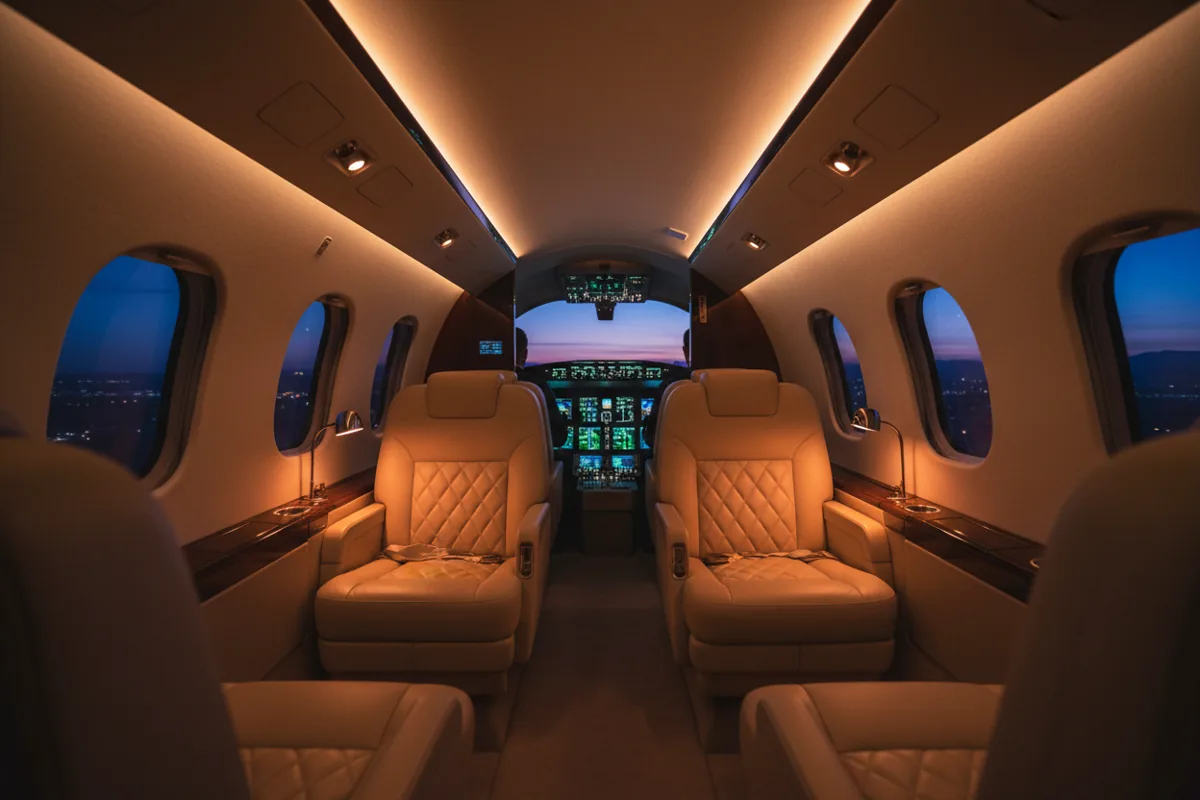
The cabin is 17.80 ft long, 5.00 ft wide and 4.83 ft high. Seats are arranged in an executive club layout and can swivel and articulate.
On the Elite II, Honda lists:
- A fully enclosed lavatory with ceiling skylights and external servicing
- Speakerless in-cabin audio
- Improved acoustic treatment to lower cabin noise
- Two-toned executive leather seats
For a small jet, the enclosed lavatory is a practical detail worth checking on any specific aircraft you charter.
Performance of HondaJet
Speed and range
The Elite II cruises at up to 422 KTAS at 30,000 ft. Its 1,547 nm NBAA IFR range assumes four occupants. With a full cabin, heavier bags or headwinds, plan on less. Ask for a route-specific estimate before you count on a long nonstop leg.
Fuel efficiency
Honda highlights efficiency as a core design goal and says it translates into lower operating costs. The over-wing engine layout, laminar-flow nose and wing, and composite fuselage are all part of that design.
Technology and safety
The Elite II includes several features that reduce pilot workload:
- Garmin Emergency Autoland, which can land the aircraft automatically in an emergency
- Autothrottle, which manages engine power through all phases of flight
- Advanced Steering Augmentation System (ASAS), which helps nose-wheel steering for better tracking on the runway
- Stabilized approach alerting, with visual and aural warnings if an approach becomes unstable
- Automated anti-ice, lighting and pressurization systems, plus automatic ground spoilers on landing or a rejected takeoff
Customer experience and cost
Maintenance and support
Honda Aircraft supports owners through a global service network and 24-hour customer support.
Ownership and operating cost
Ownership and charter prices depend on the aircraft's age, how many hours it flies, where it is based and who operates it. For charter, the main factors are the route, flight time, positioning and date.
Competitors and comparisons
Comparison with other light business jets
The HondaJet competes in the light jet segment with aircraft such as the Cessna Citation M2 and the Embraer Phenom 100.
| Aircraft | Maximum range | Maximum occupants |
|---|---|---|
| HondaJet Elite II | 1,547 nm (NBAA IFR, 4 occupants) | 1 crew + 7 passengers (alternative layout) |
| Cessna Citation M2 Gen3 | 1,550 nm | 7 |
| Embraer Phenom 100EX | 1,178 nm | 7 passengers |
Each maker measures range under its own assumptions, so treat this as a rough guide. For a charter, the better question is which aircraft available on your date can fly your route nonstop with your group.
Chartering a HondaJet with BLADE
BLADE arranges private jet charters through BLADE Anywhere, including light jets like the HondaJet. Share your dates, airports and group size, and BLADE books the aircraft with a licensed operator. All US flights are operated by DOT/FAA-licensed direct air carriers. For what drives the price, see private jet cost.
FAQs about What Is An Hondajet Jet?
What is a HondaJet?
The HondaJet is a light business jet made by Honda Aircraft Company in Greensboro, North Carolina. The current model is the HondaJet Elite II.
What are the main specifications of the HondaJet Elite II?
It has a maximum cruise speed of 422 KTAS, an NBAA IFR range of 1,547 nm with four occupants, and a maximum cruise altitude of 43,000 ft.
How many passengers does a HondaJet carry?
The typical configuration carries 6 passengers with one pilot or 5 with two pilots. The alternative configuration carries 7 with one pilot or 6 with two.
What makes the HondaJet different?
Its engines sit on pylons above the wing. This frees up cabin space by removing the structure needed for rear-mounted engines.
What safety features does the HondaJet have?
The Elite II includes Garmin Emergency Autoland, autothrottle, stabilized approach alerting, an Advanced Steering Augmentation System and automated anti-ice and pressurization systems.
How can I book a HondaJet?
Request a charter through BLADE Anywhere with your route, dates and group size. Availability of a specific aircraft type depends on the route and date.