

Introduction
The Bombardier Challenger 300 is one of the best-known jets in the super midsize class. It offers coast-to-coast range and the speed to make long domestic trips in a single leg.
Overview of Bombardier Challenger 300 Jet and Its History
Bombardier launched the aircraft at the 1999 Paris Air Show under the name Bombardier Continental. The first prototype flew on August 14, 2001. Transport Canada approved the jet on May 31, 2003, followed by US FAA certification on June 4 and European approval on July 31 of that year. Commercial operations began on January 8, 2004, and final assembly took place in Montreal.
Bombardier later developed two successors:
- Challenger 350, which first flew on March 2, 2013, and was certified in 2014. It has the same cabin size with a more modern interior, taller cabin windows, more powerful HTF7350 engines and a range of 3,200 nautical miles.
- Challenger 3500, unveiled in September 2021, which adds autothrottles and an upgraded cabin.
By July 2020, around 450 Challenger 300s and 350 Challenger 350s had been delivered.
Advantages and Disadvantages of Using Bombardier Challenger 300 Jet
The main advantages are range, speed and cabin comfort for the size. The Challenger 300 can fly across the continental United States in one hop, and every seat is berthable, so some layouts can form beds for overnight flights.
The trade-offs are cost and size. A super midsize jet generally costs more per hour to charter than a light or midsize jet. On short trips with a small group, a smaller jet is often the more practical choice.
Design and Specifications
| Specification | Challenger 300 |
|---|---|
| Engines | 2 x Honeywell HTF7000 turbofans |
| Range | 3,100 nm |
| Cruise speed | Mach 0.80 (459 kn) |
| Ceiling | 45,000 ft |
| Typical seating | 8 or 9 passengers |
Interior and Exterior Design
The fuselage and wing are aluminum structures, with composite winglets. The supercritical wing uses a fly-by-wire spoiler system that helps with roll control in flight and dumps lift on the ground after landing.
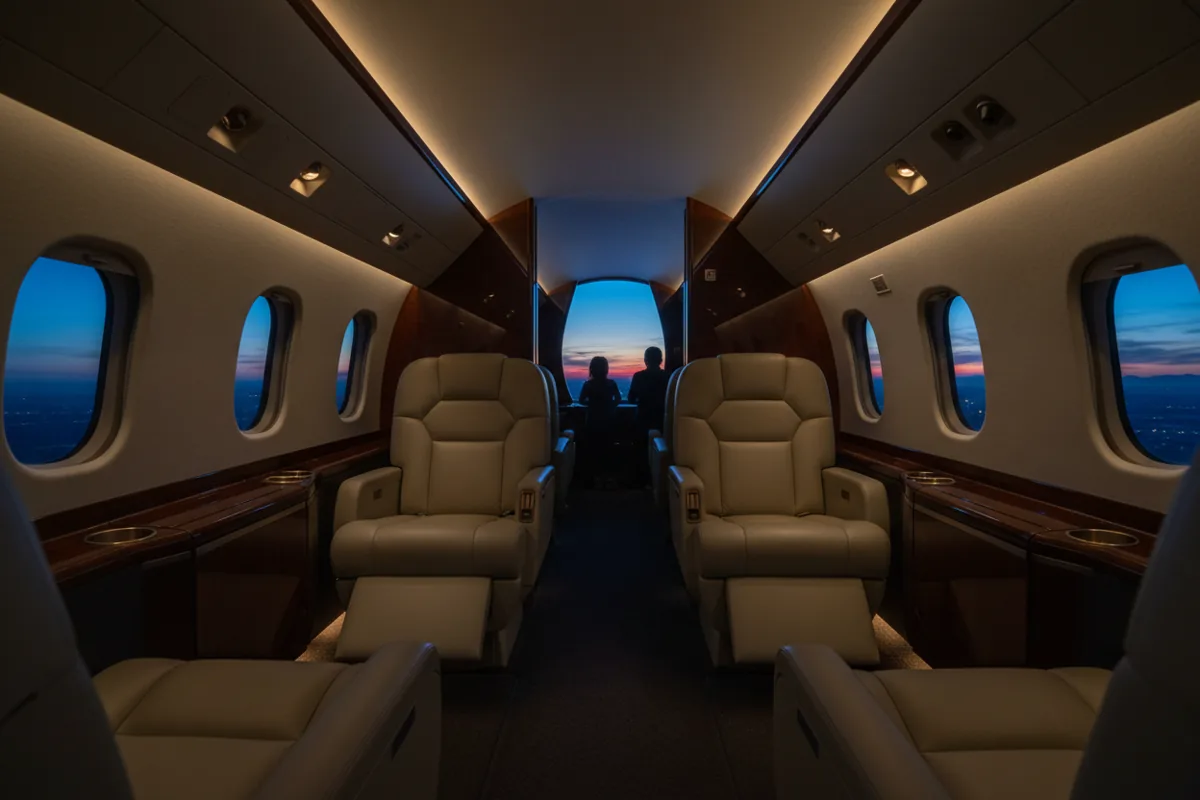
Inside, the cabin is designed for small groups on longer flights. All seats are berthable. Depending on the aircraft, you may find a three-place divan, an extra belted seat in the lavatory, power outlets, USB ports, a cabin management system and wireless connectivity.
Performance and Range
The baseline Challenger 300 has a range of 3,100 nautical miles and cruises at Mach 0.80. It can climb to 41,000 feet in about 18 minutes at maximum takeoff weight. That combination covers most domestic routes nonstop. Range on any given day depends on passengers, bags, weather and winds, so the operator confirms each route.
Capacity and Seating
Typical layouts seat eight or nine passengers. The certified maximum is 19 occupants including crew, with no more than 16 passengers, but charter aircraft are fitted for comfort rather than maximum seating.
Technology and Safety Features
Avionics System
The flight deck uses Rockwell Collins Pro Line 21 avionics with four LCD displays, an engine indication and crew alerting system (EICAS) and a maintenance diagnostics computer. The Challenger 350 adds synthetic vision on the primary flight display.
Safety Features and Cabin Pressurization System
Standard equipment includes an enhanced ground proximity warning system (EGPWS), a traffic collision avoidance system (TCAS II), an emergency locator transmitter and Rockwell Collins MultiScan weather radar. By November 2014, the Challenger 300 fleet had flown nearly one million hours with a dispatch reliability rate of 99.79 percent.
Cost and Ownership
Cost of Owning
By the 2020s, used Challenger 300s typically sold for $7 million to over $20 million, depending on age and condition. Owning one also means paying for crew, hangar, insurance and maintenance.
Operating Costs and Maintenance
In 2014, Bombardier priced its maintenance program for the type at $277 per flight hour, with inspections every 600 hours. Fuel, crew and fees vary by operator and route, so ask for a full trip quote rather than an hourly estimate.
Comparison with Other Business Jets
Comparison with Gulfstream G200
The Gulfstream G200, built from 1999 to 2011, has a range of 3,400 nautical miles at Mach 0.75 with four passengers. On paper the G200 has a little more range, but it went out of production in 2011.
Comparison with Citation Sovereign
The Cessna Citation Sovereign+ has a range of 3,000 nautical miles and seats up to nine passengers. The Challenger 300 offers a little more range.
Comparison with Hawker 900
The Hawker 900XP has a maximum range of 2,950 nautical miles and a maximum cruise speed of 466 knots. The Challenger 300 flies farther, about 3,100 nautical miles.
Chartering a Challenger 300 with BLADE
BLADE arranges private jet charters, including super midsize jets like the Challenger 300, through licensed operators. All BLADE flights in the United States are operated by FAA-licensed carriers. Share your route, date and group size, and BLADE will show you the aircraft available for the trip.