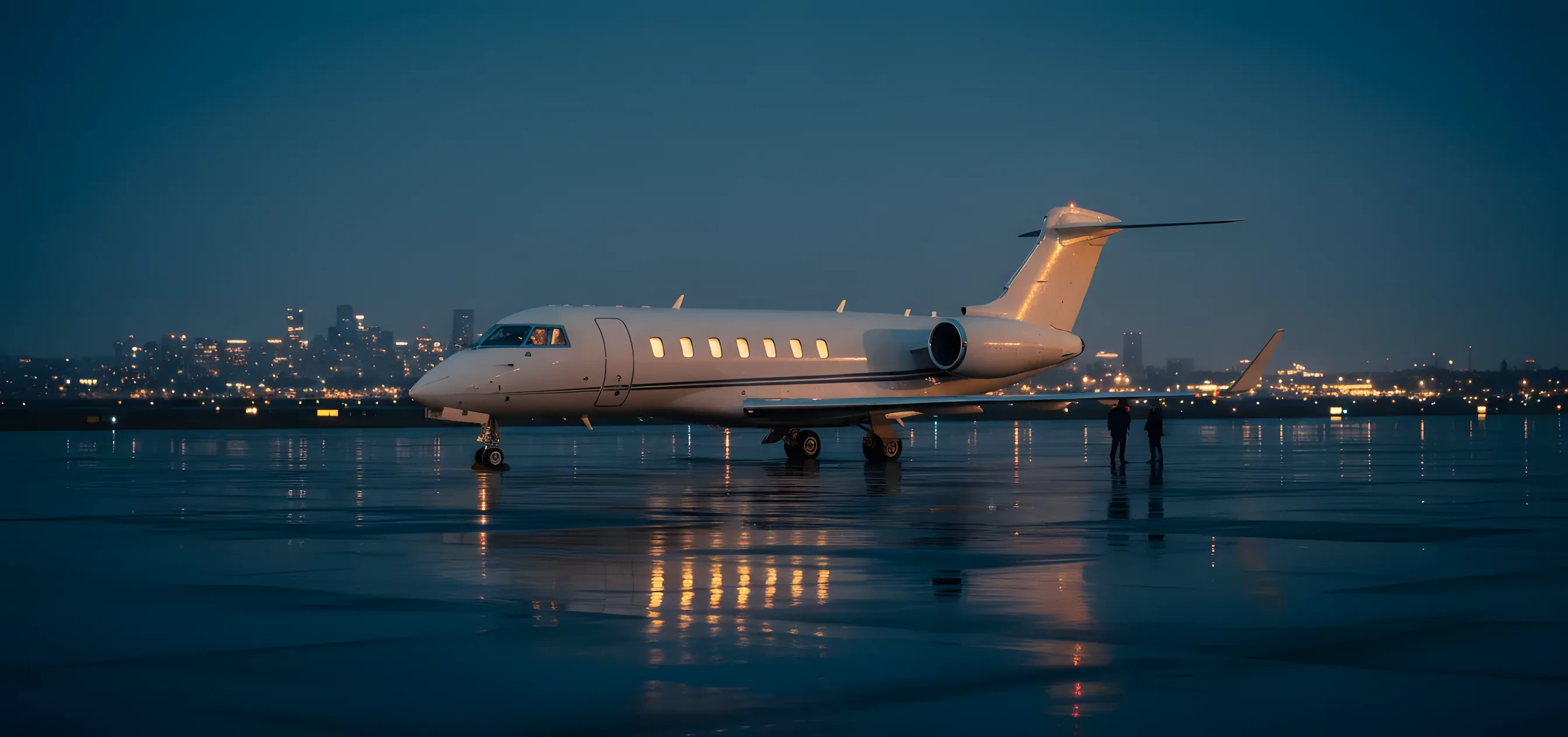

Introduction to Challenger 605 Jet
The Bombardier Challenger 605 belongs to the Challenger 600 series, a family of wide-cabin business jets that began with the Canadair Challenger in 1980. Every model in the family shares the same basic layout: a low wing, two rear-mounted General Electric CF34 turbofans on later models, and a stand-up, flat-floor cabin wider than most jets of its era.
The 605 first flew in January 2006 and was certified and introduced that year. The 200th Challenger 605 entered service in October 2012. Bombardier replaced it with the Challenger 650 in 2015.
Design and Features
The 605 is an evolution of the Challenger 604, the best-selling model in the series. Bombardier kept the proven airframe and engines and focused the changes on the cabin and the cockpit.
Exterior Design
From the outside, the 605 is easiest to spot by its larger cabin windows and its streamlined tail cone. Like the rest of the family, it has winglets, a supercritical wing and engines mounted in pods on the rear fuselage. The engines have thrust reversers to shorten landing distances.
Interior Design and Accommodations
The Challenger fuselage was designed around an unobstructed cabin floor, with a cabin height of 6 feet 1 inch in the center section. In a typical executive layout, the galley sits at the front, followed by two seating areas and a lavatory at the back.
The first seating area is usually a four-chair club. The second is a conference grouping or divans. The chairs recline fully and swivel, and the divans can be used for sleeping on longer flights. Exact layouts vary from aircraft to aircraft, so check the floor plan of the specific jet before you book.
Cockpit and Avionics
The 605 flight deck uses the Collins Pro Line 21 avionics system, with larger screens than the 604's and electronic flight bag capability. Its successor, the 650, moved to Pro Line 21 Advanced with synthetic vision.
Performance and Specifications
Bombardier's 605 and 650 improved the avionics and cabin, while their performance figures stayed similar to the Challenger 604's. For reference, the 604 can fly five passengers about 4,000 nautical miles at Mach 0.74 and cruise for 7.5 to 8 hours at Mach 0.80.
Speed and Range
Payload, weather, winds and the operator's fuel reserves decide what a specific aircraft can fly nonstop on the day, so the operator confirms each route.
Fuel Efficiency
Fuel burn is highest in the first hour of flight, while the jet is heavy with fuel, and falls as the flight goes on. Ask the operator for a trip-specific fuel and cost estimate.
Capacity and Payload
Published payload figures for the 605 vary by configuration and source, so this page does not list one. Seating depends on the layout of the individual aircraft. Tell the operator how many people and bags you are bringing, and they will confirm the aircraft can carry the load on your route.
Cost of Ownership
The Challenger 605 is no longer built, so it can only be bought on the pre-owned market. Prices depend on the year, total hours, engine program and cabin condition.
Operating Costs
Owning a large-cabin jet means paying for crew, hangar, insurance, maintenance and fuel. For travelers who fly a few times a year, chartering is usually simpler: you pay for the trips you take, and the operator provides the aircraft and the crew.
Resale Value
Resale value depends on the same factors as purchase price, plus maintenance records and avionics upgrades. An aircraft broker or current listings are the best guide.
Conclusion and Recommendation
The Challenger 605 suits groups that want a wide, stand-up cabin and long range without moving up to an ultra-long-range jet. BLADE arranges private jet charters, including large-cabin jets like the Challenger 605, through licensed operators. All BLADE flights in the United States are operated by FAA-licensed carriers. Share your route, date and group size, and compare the aircraft available.